
Introduction
Our long-standing involvement, acting for the plaintiff, in the matter of Pilatus (PTC) Limited v RBC Trustees (Jersey) Limited [2025] GCA 091 offered a rare opportunity to clarify the scope of trustee duties in complex, multi‑jurisdictional structures. The practical implications arising from the decisions in the Royal Court of Guernsey (the "Royal Court") and the Guernsey Court of Appeal ("Court of Appeal") demonstrate not only why the steps taken on behalf of our client were effective, but also why the case carries significance for trustees and fiduciaries operating globally.
Trustees face real exposure where resignations, handovers or governance protections are mishandled, and the courts made clear that trustees cannot stand idly by when inaction risks diminishing trust assets. The Court of Appeal’s finding that trustee duties can extend to non‑trust assets with a material impact on trust value has relevance far beyond Guernsey. In modern, layered structures, trustees must safeguard value wherever it sits.
Background
This matter concerns a claim by a successor trustee, Pilatus (PTC) Limited ("Pilatus"), against a former trustee, RBC Trustees (Jersey) Limited (formerly known as RBC Trustees (Guernsey) Limited before merging with RBC Trustees (Jersey) Limited in 2024) ("RBC"). Pilatus alleged breaches of trust by RBC in relation to the management and oversight of a trust structure ultimately connected to the Primefuels group of companies.
The Shallan Trust was a Guernsey discretionary trust. It held shares in Shallan Group Holdings Ltd ("SGHL"), which wholly owned Shallan Overseas Ltd ("SOL"). SOL originally wholly owned Shallan Overseas Investments Ltd ("SOIL"), which in turn held a 50% stake in Primefuels Investments Ltd ("PIL"). PIL owned 85% of Primefuels Holdings Ltd ("PFHL"), which was the principal holding company for an East African logistics business.
A simplified chart of the pre-2011 group structure: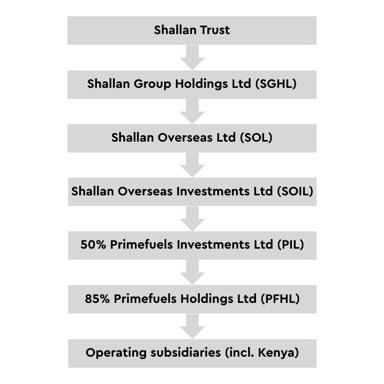
In February 2011, SOL sold SOIL to a beneficiary, Mr Somji. The commercial purpose was to enable a downstream operating company to obtain bank funding without the disclosure of trust beneficiary information. The sale, however, was accompanied by a Put & Call Option Agreement entered in July 2011, which gave SOL the right (and in certain circumstances the obligation) to repurchase SOIL within a defined window (between February 2015 and February 2017) (the "Option"). Thus, following the sale, SOIL, PIL and PFHL ceased to be trust assets, but the trust structure retained the Option - a contractual right to reacquire SOIL.
The trustee, RBC, wholly owned in-house corporate services subsidiaries that sat on the boards of PIL and PFHL. When RBC retired as trustee on 30 October 2015, it coordinated its retirement with the resignation of those group companies from their directorship and secretary roles in PIL and PFHL. Replacement appointments were arranged but failed.
Control of the companies shifted. In 2017, the Option was exercised and SOIL returned to the trust structure, but it was alleged that the loss of board balance and governance control had devalued the reacquired asset. Parallel unfair prejudice proceedings were commenced in the BVI by an underlying company (SOIL) against different defendants.
RBC sought to strike out the Guernsey proceedings by way of an exception de fond, arguing that the claim was barred by the reflective loss principle. Following determination of the preliminary issues, the defendant sought a stay of proceedings. This briefing explains why the interlocutory decisions together with the Court of Appeal judgment are of importance in Guernsey and further afield. Our Guernsey litigation team, led by Alasdair Davidson, represented Pilatus at each stage of these proceedings.
Reflective loss
The central issue was whether the trustee’s claim was barred because the losses alleged were merely reflective of losses suffered by underlying companies, which themselves had causes of action against other parties.
This required the Royal Court to consider:
- whether the reflective loss principle forms part of Guernsey law; and
- if so, whether it applies to trustee breach of trust claims, particularly where parallel proceedings exist in another jurisdiction against different defendants.
Decision
The Royal Court dismissed RBC’s exception de fond. It held that while a narrow form of the reflective loss principle does exist in Guernsey law (as part of company law and derived from Foss v Harbottle [1843] 67 ER 189), the principle did not apply to bar the trustee’s claim in this case. Accordingly, the action was allowed to proceed to case management and trial.
Following the UK Supreme Court’s decision in Sevilleja v Marex Financial Ltd [2020] UKSC 31, it was accepted that reflective loss is a limited company law rule, barring only claims by shareholders for diminution in share value that merely mirrors loss suffered by the company.
Although the trustee ultimately held shares in the corporate structure, it was not suing in its capacity as shareholder, but as trustee seeking reconstitution of the trust fund for beneficiaries following alleged breaches of trust. The Guernsey claim was against a former trustee for breach of trust, whereas the BVI proceedings also taking place were against corporate actors for unfair prejudice. The Royal Court considered this a powerful reason why the reflective loss principle should not apply.
The Royal Court was influenced by Jersey authority (Freeman v Ansbacher Trustees (Jersey) Limited [2009] JRC 003) and earlier Guernsey dicta, recognising that applying reflective loss too rigidly in a discretionary trust context could leave beneficiaries without an effective remedy.
Any risk of double recovery could be addressed through case management or remedial tailoring, rather than by striking out the claim at the outset.
Practical implications
- Guernsey courts will confine the doctrine to its proper company law boundaries.
- Poorly managed resignations, handovers, or failures to safeguard governance protections may expose trustees to liability, even where loss ultimately manifests at corporate level.
- Trustees (and beneficiaries) are not precluded from pursuing breach of trust claims merely because related corporate proceedings exist elsewhere.
The decision reinforces Guernsey’s trust centric approach: trustees cannot rely on reflective loss as a broad shield against breach of trust claims. Where trustees owe distinct fiduciary duties, those duties will be enforced regardless of parallel corporate litigation.
Stay
Following the Royal Court’s determination of the exception de fond, RBC applied for a stay of proceedings on the basis that related actions were ongoing in the BVI and Mauritius. RBC argued that decisions in those jurisdictions would be relevant to, and potentially determinative of, the issues before the Guernsey Court. Pilatus opposed the stay.
The Royal Court rejected the application, finding that RBC had not demonstrated the "compelling circumstances" required to pause domestic proceedings in favour of foreign litigation.
The Royal Court held that the Guernsey action focused on RBC’s own knowledge and conduct as trustee, rather than the lawfulness of subsequent corporate actions being disputed abroad. The parties in the BVI and Mauritian proceedings were largely different, and there was little prospect of overlapping witnesses. As a result, concerns about duplication or inconsistent findings carried limited weight.
Given that the BVI and Mauritian proceedings may take between two and ten years to conclude, the Royal Court found that a stay would risk significant prejudice through delay, including the inevitable deterioration of witness recollection.
The Royal Court also confirmed its intention to divide the Guernsey proceedings into two stages, with liability to be determined first, and quantum addressed afterwards. This approach mitigated any risk of double recovery and further undermined the justification for granting a stay.
Decision of the Royal Court
At first instance, the Bailiff found that the allegations of gross negligence could not succeed because assets within the structure ceased to be trust property once SOIL was sold, and therefore RBC had no trustee duty under section 22(1) of the Trusts (Guernsey) Law, 2007 to act en bon père de famille in relation to board appointments for those companies. However, he went on to state that, if that conclusion were incorrect, RBC’s actions (specifically convening an inquorate PFHL board meeting and resigning without securing the Trust’s interests) "amount[ed] to gross negligence".
Pilatus appealed this decision.
Decision of the Court of Appeal
The Court of Appeal unanimously set aside the Bailiff’s decision and offered helpful clarification on the scope of a trustee’s duties in relation to assets that, while not directly owned by the trust, are sufficiently connected to it such that they may influence the value of the trust property.
The Court of Appeal found that the Option was a chose in action capable of being held on trust. This meant the trustee’s duty to act en bon père de famille required more than simply holding the Option; because it had practical means to protect the trust’s economic interest. The trustee was required to take positive steps to safeguard assets to which the option related and was obliged to do so even though those companies were not trust assets.
The decision draws implicitly upon the reasoning in Bartlett v Barclays Bank Trust Co Ltd [1980] Ch. 515, where Brightman J held that a trustee holding a controlling shareholding must not stand idly by while company affairs are mismanaged. Bartlett concerned shares directly held on trust. Pilatus concerns a contractual right to reacquire shares. The extension is principled. Where a trustee’s shareholding confers control, prudence may require intervention. Where a trustee’s contractual right derives its value from a known corporate structure prudence may likewise require intervention.
The Court of Appeal did not collapse corporate personality or disregard formal ownership. Rather, it recognised commercial reality: the Option was valuable only if board balance and corporate governance were preserved. The trustee’s own conduct demonstrated awareness of that fact.
Practical implications
- Trustee duties can extend beyond assets legally owned by the trust, and a trustee may need to act in relation to non-trust assets when those assets are closely connected to, and materially influence, the value of trust property such as an option or other chose in action.
- Options constitute trust property, and a put and call option is a chose in action capable of being held on trust. Trustees therefore have a duty to preserve its value in the same way as any other trust asset.
- Practical control is the key consideration, and trustee duties arise where the trustee has the practical means and influence to protect the value of trust assets by taking steps in relation to non-trust property. Where the trustee lacks control or cannot reasonably foresee harm, liability is unlikely.
- Passive inaction may amount to negligence, and trustees cannot stand idly by when they know that their actions, or their failure to act, will foreseeably diminish the value of trust assets, even if protecting those assets requires involvement with downstream companies no longer owned by the trust.
- Poor handovers and sudden resignations carry significant risk, and inadequate succession planning, inquorate meetings, or resigning from control positions without safeguarding the trust’s interests may constitute gross negligence for professional trustees.
Conclusion
The Court of Appeal stressed that extending trustee duties to non-trust assets will not arise in every situation, it will depend on the particular facts, the foreseeability of risk, and the trustee’s practical ability to act. However, the decision serves as a practical warning for professional trustees acting across offshore jurisdictions. It highlights the need for careful and prudent management during restructurings, exits, and handovers (especially where the value of the trust depends on corporate control that sits outside the trust structure).
Location: Guernsey
Related Services: Litigation & Dispute Resolution | Contentious Trusts & Probate